
Ready to find the right home in the Triangle? Let’s talk strategy before you tour a single property.
Schedule My Home ConsultationThe 30-second version
- Not a lump sum. A construction loan releases money in stages called draws, tied to finished milestones — foundation, framing, dry-in — and you pay interest only on what your builder has drawn.
- One loan beats two. A construction-to-permanent loan funds the build and converts to a 15- or 30-year mortgage at the Certificate of Occupancy, so you close once instead of twice.
- Lenders want more. Plan on a stronger credit score, 20–30% down, a DTI under 43%, and a builder who is licensed, insured, and bonded in North Carolina.
- Your builder gets underwritten too. The bank vets the general contractor as hard as it vets you — track record, financials, and insurance all get checked before dirt moves.
Building a custom home in the Triangle is a different animal from buying one. There is no finished house to appraise, no seller to negotiate — there is a lot, a set of plans, and a builder who needs to get paid as the walls go up. That is exactly what a construction loan is built to handle, and in my 17+ years across Raleigh-Durham I have walked clients through the whole run, from a bare lot to the Certificate of Occupancy.
Get the financing structure right at the start and the rest of the build has room to breathe. Get it wrong and you are closing twice, paying two sets of costs, and gambling on where rates land a year from now. Here is how these loans actually work, and what lenders want before they hand over a dime.
What a construction loan actually is
A construction loan is short-term financing that pays to build a property where none stands — raw land, a tear-down and rebuild, an infill lot in an established neighborhood, or a renovation big enough to change the home's value. The money does not arrive all at once. It comes out in draws, pre-set payments released as your builder finishes specific stages of the job.
Here is the part that protects your cash flow: you pay interest only on the funds that have been drawn and paid to the builder, not on the full loan amount. During the months when the build is eating your attention, your payment stays small. Every draw request also triggers a formal inspection by the lender or a third-party appraiser — the work has to be done, to code, before the next check clears. That structured disbursement keeps the project on schedule and on budget, and it keeps both you and the bank honest.
Custom build or production home? The distinction sets the whole path
Whether you need a construction loan at all comes down to who is carrying the build.
A production home goes up inside a subdivision built by a large-scale builder. That builder owns the land and uses its own corporate financing — a builder line of credit — to construct homes from a menu of floor plans. You pick a lot and a plan, and you show up at the end with a conventional mortgage (a Fannie Mae or Freddie Mac loan) to buy the finished house. No construction loan needed. The builder carried the risk.
A custom home flips that. You own the land, you hire the architect and the builder, and you commission a one-of-a-kind house to your specs. In that scenario, you are the developer — which means you secure the financing from day one. That is where the construction-to-permanent loan does its work, funding the project from breaking ground to the final coat of paint.
On a custom build, you are not just the buyer. You are the developer — and the loan is built around that.
How a construction loan differs from a regular mortgage
Both finance a home. Their machinery is nothing alike.
Construction loan
- Money released in draws, paid to the builder in stages
- Each draw verified by a formal site inspection
- Interest-only payments during the build, on drawn funds only
- Short-term — covers the building phase, then pays off or converts
Regular mortgage
- One lump sum at closing to buy a finished property
- One appraisal of an existing home up front
- Full principal-and-interest payments from month one
- Long-term — 15- or 30-year fully amortizing loan
The bridge between the two is the conversion. Many construction loans — the construction-to-permanent products — are engineered to roll into a standard, fully amortizing mortgage once the Certificate of Occupancy is issued. That is the moment your short-term build loan becomes the long-term home loan you live with.
Ready to find the right home in the Triangle? Let’s talk strategy before you tour a single property.
Schedule My Home ConsultationThe four loan structures, and who each one fits
Construction financing is not one product. Four structures dominate, each with a real trade-off.
| Loan type | How it works | Best for |
|---|---|---|
| Construction-only | Short-term, typically a 12-to-18-month term covering the build; must be paid off or refinanced into a separate permanent mortgage — a second closing. | Buyers who want to shop the best permanent rate later and can stomach rate risk plus two sets of closing costs. |
| Construction-to-permanent (CTP) | Single closing. Funds the build and automatically converts to a long-term mortgage at completion. Lets you lock the permanent rate at the outset. | Most custom builders — fewer fees, less paperwork, protection against rising rates. |
| Owner-builder | Borrower must be a licensed, insured general contractor with a real track record. Higher down payment and exhaustive documentation. | Professional builders constructing their own residence. A rare and demanding path. |
| Renovation | Loan amount is based on the after-renovation value (ARV), bundling purchase price and renovation budget into one package. | Buyers acquiring a property with a major remodel already planned. |
For most of my clients building custom in Raleigh-Durham, the construction-to-permanent loan is the workhorse. One closing, one rate lock, one team managing the conversion — and no scramble to refinance while you are still picking out cabinet pulls.
Who these loans are built for
This financing is engineered for people who have a clear vision and understand what a build demands. It fits:
- Custom homebuyers who want full control of the design, materials, and finishes.
- Real estate investors developing high-value or niche properties where the design drives the return.
- Homeowners taking on renovations or additions big enough to change the home's structure and value.
- Owner-builders — the rare licensed general contractor building for themselves, and willing to clear a lender's toughest underwriting.
What lenders really want to approve you
Qualifying for a construction loan is a harder process than a conventional mortgage. Here is the unvarnished version of what the bank checks.
Credit, down payment, and DTI
- Credit score. Most North Carolina lenders set a floor around 680–720 on construction products. A FICO of 740 or higher makes you a prime candidate for the best rates. FHA construction options sometimes open the door at 620+, usually at higher rates and with mortgage insurance.
- Down payment. Plan on 20–30% of total project cost — the loan-to-cost, or LTC. Own your land outright? Its appraised value typically counts as equity toward that requirement. Gift funds are allowed, but every dollar has to be documented and sourced.
- Debt-to-income. Lenders generally want DTI below 43%, sometimes stretching to 45% for strong borrowers with high scores or deep reserves. Note the trap: your DTI is calculated on the projected payment of the fully amortized permanent mortgage — not the small interest-only payment during construction.
The builder gets vetted as hard as you do
The bank underwrites your general contractor as thoroughly as it underwrites you. A non-negotiable requirement is a builder who is:
- Licensed, insured, and bonded in North Carolina.
- Backed by a proven track record of completed projects in the Triangle.
- Able to hand over financial statements, trade references, and proof of liability insurance.
The paperwork — your "blue book"
Approval hinges on a complete, tightly organized document package, often called the blue book. It includes:
- Detailed architectural plans, specifications, and a line-item budget.
- A full construction timeline, from site work to final inspection.
- Signed contracts with the general contractor, major subs, and suppliers.
- An appraisal based on the as-completed value of the future home. Loan amounts typically cap at 80–90% of that appraised completed value.
The custom build process in Raleigh-Durham
A custom build runs in stages, from setting a budget to breaking ground. Here is what to plan for.
Setting your budget
In this region, a custom build often starts in the $300,000 to $450,000 range excluding land, with luxury projects frequently topping $500,000 (Source: Houzeo, 2025). A real budget — your pro forma — accounts for:
- Materials: around $50 per square foot, moving with grade and availability.
- Labor: competitive wages for the skilled trades a custom build demands.
- Permits and fees: a baseline $70 building permit, plus electrical, HVAC, plumbing, septic, and driveway fees.
- Land: roughly $20,000 per acre on average, though it swings hard with location and zoning.
- Contingency: a reserve of 10–15% is not optional. It covers the overages that always show up.
From plans to closing
Once the budget is set, the application runs its course: select and vet your builder, produce final plans and contracts with your architect and designer, meet with a lender and submit your financial profile plus the blue book, order the as-completed appraisal and a title search, clear underwriting, and close — sign the documents, fund the down payment, and break ground.
Ready to find the right home in the Triangle? Let’s talk strategy before you tour a single property.
Schedule My Home ConsultationManaging the loan once the build starts
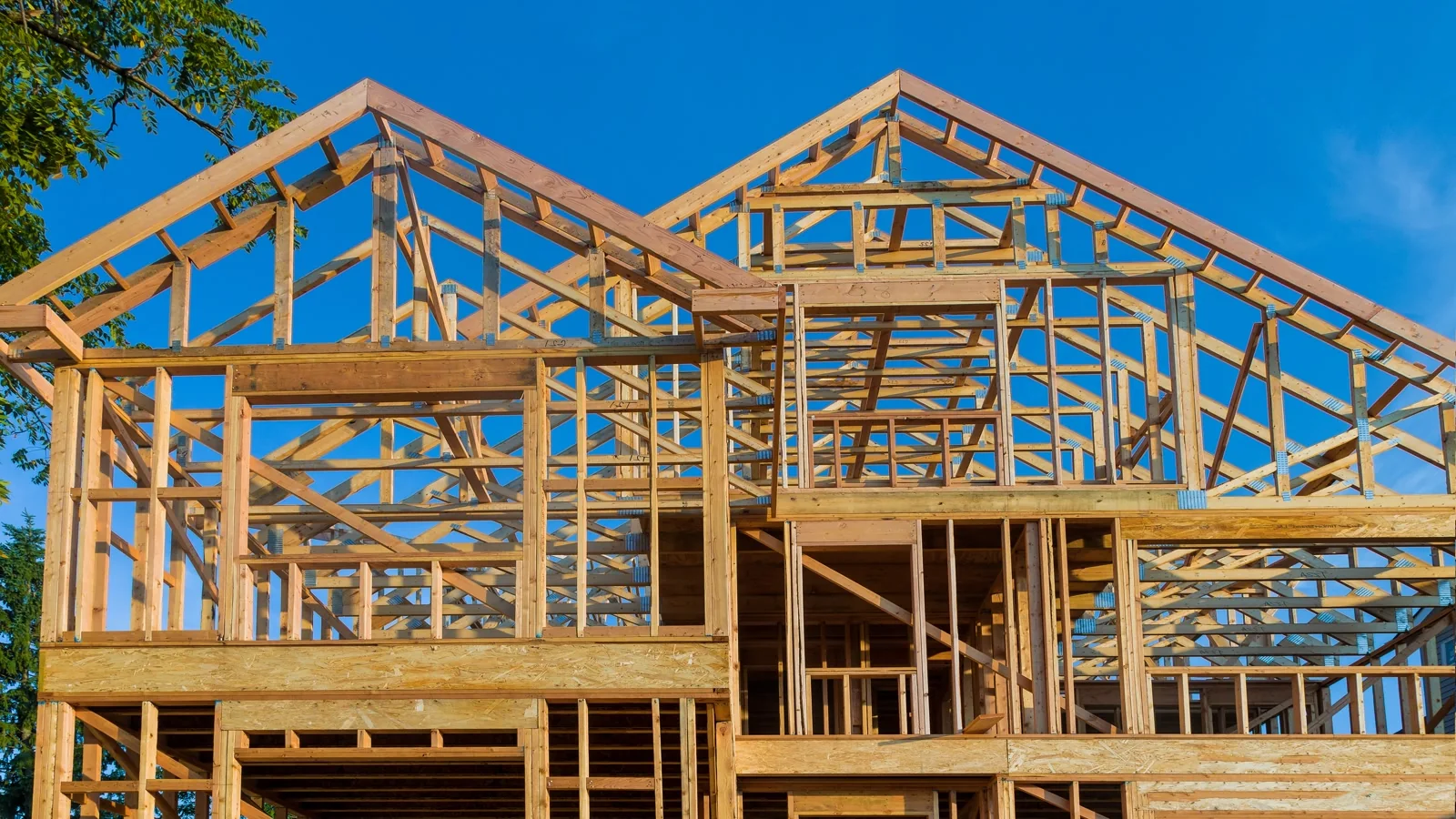
The money moves on a draw schedule, released as your builder clears each milestone — and every draw brings an inspector to the site.
The draw schedule
Funds release in stages that track the build:
- Foundation poured and cured
- Framing completed
- Mechanicals — plumbing, electrical, HVAC — roughed in
- Dry-in — windows, doors, roofing installed
- Final inspection and Certificate of Occupancy
Each draw request triggers a site inspection to confirm the work is finished and matches the plans. It is accountability built into the money itself.
Keeping the team in sync
A clean build runs on communication between you, your builder, your architect, and your lender. Set clear channels with the builder for handling change orders. Treat the inspector as a quality-control partner protecting your investment, not an obstacle. And answer your lender fast — a slow reply to a document request is how draws get delayed.
Handling the surprises
Weather, supply-chain hiccups, a mid-build design change — even a tight plan hits them. Three moves keep them from derailing you: hold that 10–15% contingency in the budget, document every modification with a signed change order approved by all parties including the lender, and keep communication open across the whole team so problems surface early.
Rates and terms
Construction loan pricing shifts with the market, so treat any number here as a snapshot, not a quote. As of 2025, construction loan interest rates in North Carolina ran roughly 6.9% to 9.75%, with the final rate driven by the project's risk profile and your qualifications. A one-year construction phase is standard, after which the loan converts into a 15- or 30-year fixed-rate or adjustable-rate mortgage. In a rising-rate stretch, locking your permanent rate as early as possible is the smart move. Confirm current rates and terms with your lender before you build a budget around them.
Development Budget Calculator
Interest accrues on what you have drawn, not the commitment. Model your schedule.
Open the calculator →Ready to break ground
Building custom in Raleigh-Durham turns a plot of land into a home built to your exact specs — and the financing is what makes it possible. If you want to talk through your options, dig into the numbers, or get connected with vetted Triangle builders, my team and I will follow up and help you plan the move.
- Decide custom or productionIf a builder carries the land and construction, you just need a conventional mortgage. If you own the land and commission the build, you need construction financing from day one.
- Pick your loan structureFor most custom builds, a construction-to-permanent loan means one closing, one rate lock, and one conversion instead of two.
- Get your file in shapeStrengthen your credit, line up 20–30% down, keep DTI under 43%, and choose a builder licensed, insured, and bonded in North Carolina.
- Build the blue bookPlans, line-item budget, timeline, signed contracts, and an as-completed appraisal — the complete package is what gets you approved.
- Confirm today's rates with a lenderPricing moves. Get a current quote and lock your permanent rate before you set the budget.
Ready to find the right home in the Triangle? Let’s talk strategy before you tour a single property.
Schedule My Home Consultation