Thinking about selling? I’ll tell you what your property is really worth — no obligation.
Get My Free Home EvaluationA seller called me last week, frustrated. Her beautifully renovated North Raleigh home had been sitting on the market for 47 days with only three showings; within two hours of walking through it, I found the problem — every room said "my house, my style, my life" instead of "your potential dream home." We staged it properly, relisted with fresh MLS photos, and had it under contract in nine days with multiple offers.
This guide covers everything sellers ask me about home staging in the Raleigh-Durham market: what staging costs, how much staged homes sell for, DIY versus professional staging, virtual staging for vacant homes, and the room-by-room techniques that actually generate offers. After 18 years leading the Tim M. Clarke Team through hundreds of staged Triangle listings and comparative market analyses (CMAs), these are the battle-tested strategies that consistently cut DOM (Days on Market) and raise final sale prices for my clients in Wake, Durham, and Orange County.
What Home Staging Is and Why It Works
Home staging is the strategic preparation and presentation of your property so the widest possible pool of buyers can picture themselves living in it. It has evolved from a luxury service reserved for high-end listings into a necessity across every price point in the Triangle. I'm not talking about tossing a few throw pillows on the couch. Real staging is a strategic marketing investment that directly impacts your bottom line, often returning 5-15 times what you spend on it.
Here's what most sellers don't realize: buyers touring homes in person have almost always already seen your property online through MLS listings, Zillow, or Realtor.com. If your listing photos don't capture attention immediately, you've lost buyers before they ever request a showing. In our market, where the average buyer views 8-10 homes before making an offer, your property has to be memorable enough to make the shortlist.
Buyers Decide on Emotion First
When buyers walk through a properly staged home, their brains process the space differently than an empty or cluttered property. They spend more time imagining their furniture placement, their morning routine in that kitchen, their kids in that backyard. Buyers make offers based on emotion and justify them with logic later. I've watched a couple tour ten similar homes in Cary or Chapel Hill and write an offer on the one where they could "just see themselves living there." Staging creates that visceral response.
The most effective staging sells a lifestyle narrative, not just square footage. In a custom-built home in North Raleigh, we might stage the bonus room as a home theater for entertainment-focused buyers. Near Research Triangle Park (RTP), we absolutely stage a bedroom or flex space as a high-functioning home office, because so many RTP professionals work hybrid schedules; a built-in desk or Ethernet ports suddenly become major selling points. A screened porch staged with comfortable seating and an outdoor rug resonates deeply with Triangle buyers who want spring and fall evenings without the mosquitoes. A mudroom staged with hooks, baskets, and a bench near the garage? Parents instantly connect with the solution to their daily chaos.
The Eight-Second First Impression
You get roughly eight seconds when a buyer pulls up to your home. That's it. Eight seconds before they've mentally filed your property as "must-have," "maybe," or "pass." In the Triangle specifically, first impressions extend past the front door: the sightline from the foyer into the main living spaces has to be carefully curated. Many of our homes, especially custom builds in North Raleigh, Cary, and Chapel Hill, feature open floor plans where the kitchen, living room, and outdoor spaces are all visible from the entry. That entire visual corridor needs to tell one cohesive, appealing story in those first seconds.
Homes that nail the first impression consistently generate better showing feedback from buyer's agents. That feedback determines whether your home makes the second-showing round, and second showings are where offers happen.
The Financial Case: 3-8% More Money
Staged homes in the Raleigh-Durham area typically sell for 3-8% more than comparable unstaged properties. On a $450,000 home, right around the median for well-located properties in our market, that premium translates to $13,500 to $36,000 in additional proceeds. Even after subtracting staging costs of $2,500-$6,500 for full-service professional staging, you're netting substantial additional profit.
The National Association of Realtors data showing 1-5% increases is actually conservative compared to what we see in the Triangle, particularly in the luxury and custom home segment where buyers have heightened expectations for presentation. I've had custom homes in the $700,000-$1.2M range in North Raleigh and Durham receive $25,000-$50,000 over initial list price specifically because staging helped buyers see the full potential of architectural features and high-end finishes.
Just as important: staging helps prevent price reductions. An unstaged home that sits inevitably requires price drops to generate renewed interest, and each reduction signals desperation to buyers and weakens your negotiating position. Proper initial staging keeps you out of that downward spiral entirely.
Faster Sales, Lower Carrying Costs
Time is money in real estate, especially if you're carrying a mortgage on the home you're selling while paying for your next one. In the current Triangle market, staged homes average 21-35 days on market versus 45-67 days for unstaged comparables. That's real money saved on mortgage payments, utilities, insurance, and the stress of managing a vacant property.
Well-staged homes routinely receive offers within the first two weeks, often during the critical first weekend when showing activity peaks. Buyers read homes that show well as "in demand," which creates urgency. Homes that linger past 60 days develop a stigma; buyers wonder "what's wrong with it?" even when the only issue was poor presentation.
Seasonality raises the stakes. Spring and fall are traditionally our strongest selling seasons, so reducing DOM can mean the difference between selling at peak demand or carrying your listing into a slow stretch. A home that lists in September and sells in October captures strong fall buyer activity. That same home sitting unsold into late November faces dramatically thinner buyer traffic heading into the holidays.
Who Should Stage, and How Much Staging You Need
Every seller benefits from some level of staging, but the right level depends on your price point, whether the home is occupied or vacant, and how it's currently performing. Here's how I sort it out with clients on the first walkthrough:
| Your Situation | First Question to Ask | Right Next Step |
|---|---|---|
| Occupied home in good shape, under $350,000 | Can I declutter hard and execute a plan myself? | Book a $200-$400 stager consultation, then DIY the plan with your own furniture |
| Vacant home at any price point | Will buyers grasp room scale from photos of empty rooms? | Hybrid approach: physically stage the main living spaces, virtually stage the rest |
| Custom or luxury home above $450,000 (North Raleigh, Preston, ITB Raleigh) | Do my photos justify my asking price against competing listings? | Full-service professional staging plus twilight and drone photography |
| Home already sitting 45+ days with weak showing activity | Is feedback citing clutter, darkness, or dated presentation? | Restage, reshoot the photos, and review my guide to reviving a listing that isn't selling |
| Selling while living in the home with kids or pets | Can we realistically keep every room show-ready daily? | Light occupied staging plus a strict showing preparation routine |
| Dated finishes competing against new construction | Which one or two updates change the photos most? | Targeted pre-list updates (paint, lighting, hardware), then stage to showcase them |
If you're not sure which row you're in, that first-question column is exactly what I work through with sellers during a listing consultation, alongside pricing and timing.
What Home Staging Is Not
Mismatched expectations kill staging results, so let me draw the boundaries clearly.
Staging is not decorating. Decorating expresses your personal taste; staging deliberately neutralizes it so buyers of different backgrounds, lifestyles, and aesthetics can all project themselves into the space. If a choice makes the home feel more like you, it's probably working against the sale.
Staging is not a cover-up for condition problems. No amount of white towels hides a roof leak, and buyers' inspectors will find what staging conceals. If your home has deferred maintenance, address it before listing; a pre-market inspection tells you exactly what buyers will discover so nothing torpedoes your contract later. Poor staging layered over poor condition signals shortcuts everywhere.
Staging is not a substitute for correct pricing. The best-staged home in the Triangle still sits if it's priced 10% over the comps. Staging and pricing work together; when I see strong showing traffic with no offers, pricing is usually the bigger culprit.
Staging is not "a few throw pillows." Half-hearted staging is arguably worse than none, because amateur execution makes buyers question what else you cut corners on.
Virtual staging is not a stand-in for reality. Digitally furnished photos must be clearly disclosed in the listing, both legally and ethically. Buyers who expect a furnished home and walk into an empty one feel deceived, and that poisons the showing.
Thinking about selling? I’ll tell you what your property is really worth — no obligation.
Get My Free Home EvaluationHow the Staging Process Works
Whether you go DIY or full-service, the sequence is the same. Here's how my team runs it on a typical Triangle listing:
Step 1: Walkthrough and Staging Plan
I walk the property room by room, identify the target buyer for your specific home and neighborhood, and flag what stays, what goes, and what gets added. This is where we decide the bonus room's identity: home theater, playroom, office, or fifth bedroom, depending on who's most likely to buy your home.
Step 2: Declutter and Depersonalize
Remove 40-50% of belongings from each room and every personal item that keeps buyers from projecting themselves into the space. Details below, because this step is where most sellers struggle.
Step 3: Repairs, Paint, and Light Updates
Knock out the small stuff buyers notice: touch-up paint in a proven neutral, brighter warm-toned bulbs, updated hardware, professional window cleaning. If bigger updates are on the table, my guide to maximizing your home's value before selling covers which ones actually return their cost.
Step 4: Stage the Rooms
Furniture placement, lighting layers, and finishing touches, prioritizing the spaces buyers weigh most: living room, kitchen, owner's suite, bathrooms, and entry.
Step 5: Professional Photography
Photos happen only after staging is complete. Never let a photographer shoot a half-staged house; those images live on the MLS for the life of the listing.
Step 6: Launch, Then Adjust on Feedback
We track showing feedback and market response for the first two weeks and tweak the staging if a pattern emerges. The market tells you what's working.
Decluttering and Depersonalizing
This is where most sellers struggle emotionally, and I understand why. You're being asked to strip away the very things that made this house your home. But buyers can't envision themselves in your space if it's overwhelmed with your identity.
The Art of Minimalism
Visual clutter shrinks perceived square footage and distracts from architectural features. My specific recommendation: remove 40-50% of your belongings from each room before we even think about staging. Yes, that feels extreme. But rooms with appropriate negative space photograph better, show better, and let buyers focus on the features that justify your price, like crown molding, hardwood floors, built-in shelving, and architectural windows.
Start with surfaces. Kitchen countertops should be 90% clear. Bathroom vanities completely clear except one curated styling vignette. Nightstands down to a lamp and maybe one small decorative item. Bookshelves roughly 60% full; pack the rest. This creates the spacious, uncluttered feel Triangle buyers consistently rank as a top priority in showing feedback.
For clients in custom homes with unique features such as timber-beamed ceilings, floor-to-ceiling stone fireplaces, shiplap accent walls, or wine rooms, decluttering becomes even more critical. Those architectural investments need to be the star, and every piece of clutter competes for the same visual attention.
Removing Personal Items
Family photos, kids' artwork on the refrigerator, college memorabilia, religious items, political stickers on garage storage: all of it goes into storage during the listing period. This isn't about hiding who you are. It's about creating a neutral canvas. I've seen deals nearly fall apart over personal items that created subconscious barriers; a home in Durham's historic districts plastered with one political party's signage immediately alienates roughly half of potential buyers. Your goal is the widest possible buyer pool. Save the self-expression for the next house.
The one exception: tasteful, neutral art that complements the home's style can stay. An abstract piece or landscape photography works. Your hunting trophy collection probably doesn't.
Furniture Arrangement That Sells Square Footage
Furniture placement has enormous impact on how spacious and functional rooms feel. Most homeowners arrange furniture for their own daily comfort. Staging optimizes for visual flow and room dimensions instead.
Creating Flow
When a buyer enters a room, there should be an obvious, unobstructed path through the space, with furniture defining zones rather than creating barriers. In open-concept floor plans, extremely common in Triangle new construction and custom homes, arrangement matters even more because furniture is what separates kitchen, dining, and living areas without walls.
A common mistake: oversized sectionals dominating living rooms. In many Raleigh-Durham homes built in the last 15 years, living rooms are smaller than you'd expect because square footage went into expanded kitchens and owner's suites. A massive sectional makes these rooms feel cramped; a standard sofa and two accent chairs restores proportion and lets buyers see the full dimensions. Furniture scale cuts both ways: in a great room with vaulted ceilings, appropriately sized pieces keep the space from feeling cavernous, while swapping a full-size bed for a twin or daybed makes a modest secondary bedroom feel adequate instead of cramped.
Highlighting Key Features
Use furniture to draw the eye toward your home's best assets. A gas fireplace with custom tile surround should anchor the seating arrangement. Walls of windows overlooking a wooded lot, highly desirable in the Triangle, deserve seating oriented toward the view.
In custom homes where clients invested in coffered ceilings, tray ceilings, wainscoting, or custom built-ins, furniture should complement rather than compete. A beautiful built-in bookcase flanking a fireplace gets lost next to a massive entertainment center on the adjacent wall. Staging creates visual hierarchy, leading the buyer's eye to the features that justify your asking price.
Thinking about selling? I’ll tell you what your property is really worth — no obligation.
Get My Free Home EvaluationLighting and Ambiance
Lighting might be the most underestimated element of successful staging. Poor lighting makes beautiful homes feel dark, small, and unwelcoming. Great lighting opens spaces up and creates the warmth emotional connections are built on.
Natural Light Maximization
The Triangle gets abundant sunshine most of the year, and your staging needs to showcase natural light, not block it. Open all window treatments for showings and photography. Replace heavy, dark curtains temporarily with sheer panels or solar shades that keep privacy while letting light through. This matters most in homes with southern or western exposures and intense afternoon sun; you might need blackout curtains for your own comfort, but during the listing period, maximize brightness. Buyers here consistently rate "bright and airy" as a top priority.
Window cleanliness matters more than you think. Professional cleaning inside and out, before listing photos and showings, makes a measurable difference in how light enters the space. Budget $150-$300; it's money well spent.
Artificial Lighting Strategies
Every room should have multiple light sources at different levels. Layered lighting, combining ambient overhead, task lighting like desk lamps and under-cabinet strips, and accent pieces like table lamps, creates depth that makes spaces feel professionally designed. Relying on a single harsh overhead fixture is the worst option.
Because we get earlier sunsets in winter and lots of evening showings with our dual-income buyer demographic, homes need to feel warm under artificial light. I recommend warm-toned bulbs (2700-3000K color temperature) throughout living spaces; cool-toned bulbs read sterile. Dimmer switches let you tune intensity to natural light levels, and installing them on key fixtures is an inexpensive pre-listing upgrade that adds real perceived value.
Room-by-Room Staging Guide
Here are the specific strategies for each space, with the Triangle-market preferences called out where they differ from generic advice.
Living Room and Great Room
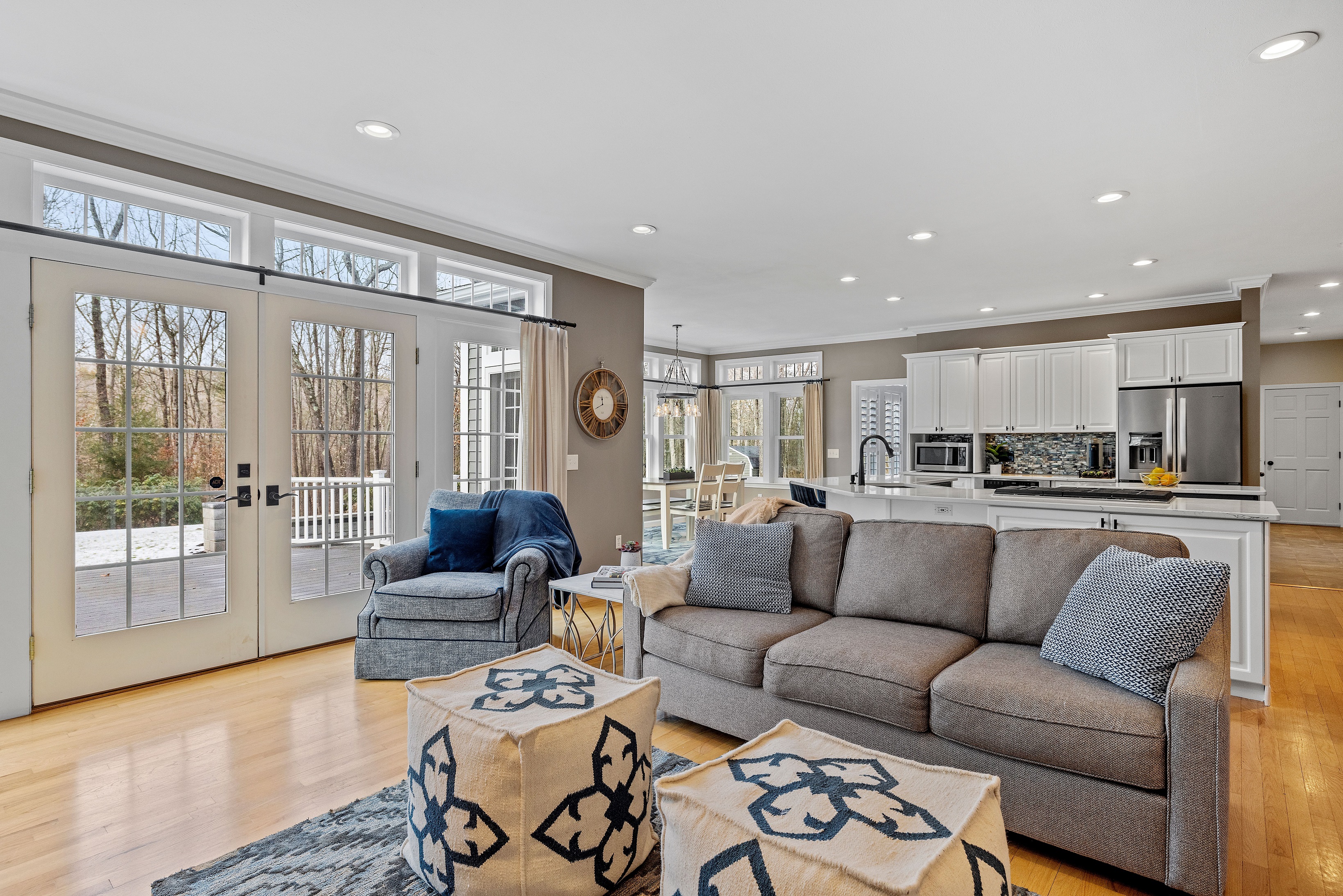
The living room sets the tone for the whole home. The classic mistake is pushing all furniture against the walls, which actually makes rooms feel smaller. Pull pieces away from walls to create a defined seating area with breathing room behind them. Textiles add warmth without commitment: a throw draped over a sofa arm, 3-5 decorative pillows maximum, and a textured area rug defining the seating zone.
Identify the room's strongest architectural feature and orient everything toward it. In many Raleigh-Durham homes that's the fireplace; style the mantel minimally with a mirror or single piece of art and maybe two matching candlesticks. If the best feature is a wall of windows over a wooded lot or landscaped yard, face the seating outward and add a side table with a coffee cup to suggest the morning-coffee-with-a-view lifestyle. Triangle buyers, especially relocators from urban markets, prize outdoor connections: if you have French doors or sliders to a patio, make that connection obvious.
Underutilized bonus rooms and flex spaces adjacent to living areas are common in Triangle custom builds. Define the purpose: secondary living space or media room if it's large, home office or reading area if it's modest. Undefined space feels wasted; purposeful space adds perceived value.
Kitchen
The kitchen is the most scrutinized room in the house, period. Buyer's agents consistently report that kitchens make or break deals in our market, so be ruthless. Countertops should be virtually empty: pack the knife block, dish soap, and paper-towel holder, and leave perhaps a high-end coffee maker, a wooden cutting board against the backsplash, and a small bowl of lemons or a potted herb. Cluttered counters make spacious kitchens feel inadequate; clear counters make modest kitchens feel workable, and counter space is a top Triangle kitchen priority.
Design investments need to be visible: custom tile backsplash, granite or quartz countertops, upgraded fixtures. If you have open shelving, increasingly popular in Triangle custom homes and renovations, style it with matching neutral dishes, one or two cookbooks upright, and a small plant; curated and minimal, never the mismatched mug collection. Pendant lighting over islands is a major design element here, and if yours is dated in a competitive price point, modern pendants can be installed for $200-$400 with significant visual impact. Stainless appliances, the sink, and the faucet must be truly spotless before every showing; buyers notice fingerprints. Kitchen table staging depends on the floor plan: keep it bare or minimal if you have a dedicated dining room, or set the eat-in area simply with placemats and a small centerpiece if it's the primary dining space.
Bedrooms
Bedrooms need to feel like peaceful retreats. In the owner's suite, invest in hotel-quality bedding: a crisp white or neutral duvet cover, 5-7 pillows layered for that luxury-hotel look, and a bed skirt if the frame shows. A bench or ottoman at the foot of the bed adds sophistication and improves photo composition. Triangle custom homes often include sitting areas in the suite; stage them purposefully with two chairs, a side table, and a reading lamp rather than leaving them empty or filled with orphan furniture.
Walk-in closets are a massive selling point in our market and need to be organized and partially empty. If yours is packed, move at least 40% of the contents to storage, and consider inexpensive modular closet organization systems from IKEA or The Container Store to make the space look more functional.
Secondary bedrooms should demonstrate versatility, because Triangle buyers have mixed needs: kids, home offices, guests, hobbies. With three spare rooms, I'd stage one as a neutral kid's room (white bedding, a few colorful accent pillows, no character sheets), one as a home office with a simple desk and chair, and one as a guest room. Small bedrooms get minimalist treatment: a full or even a twin in a daybed arrangement, one nightstand, one lamp.
Bathrooms
Bathrooms need to feel clean, spa-like, and well-maintained, because buyers know they're expensive to update. Fluffy, pristine white towels are non-negotiable: they photograph beautifully and never clash with your tile. Fold them on towel bars or a ladder shelf if you're going for the farmhouse look popular in Triangle homes. On the vanity, three items maximum: coordinating soap dispensers, perhaps a candle or a small succulent. In master bathrooms with soaking tubs, a feature Triangle luxury buyers expect, stage the surround with a bath caddy holding a wine glass and a book, or a rolled white towel on the tub edge.
Smaller bathrooms, common in older neighborhoods like Raleigh's Cameron Village or Durham's Trinity Park, need everything off the counters except one styling element, and spotless mirrors to bounce light. If you have a pedestal sink, resist adding visible storage baskets; the temporary inconvenience beats the visual clutter. Lighting is critical: if the bath has one weak bulb, upgrade the bulbs, or replace a dated fixture entirely. Modern brushed nickel or matte black fixtures run $80-$200 and make bathrooms feel updated.
Curb Appeal and Outdoor Living Spaces
In the Raleigh-Durham market, outdoor living spaces carry enormous weight. Our climate allows outdoor enjoyment most of the year, and buyers specifically hunt for appealing exterior spaces.
Curb Appeal
First impressions start at the curb. Landscaping maintenance is table stakes: mow, edge, trim, weed, and add fresh mulch. Our red clay soil creates bare spots, so reseed where needed. Professional landscaping cleanup runs $300-$800 depending on lot size and returns multiples in perceived value. Seasonal color near the entrance makes homes feel welcoming: pansies in cooler months, petunias or marigolds in summer, ideally two large planters flanking the front door at $80-$150 for planted containers.
The front door itself warrants attention. A new door with modern hardware costs $800-$2,500 depending on style, with exceptional ROI; if that's not in the budget, repaint and install a modern lockset and handle in brushed nickel, matte black, or oil-rubbed bronze for $100-$200. House numbers should be visible and attractive, and outdoor lighting earns its keep for evening showings: updated coach lights at the garage, a modern porch light, landscape lighting along walkways.
Backyard Living
Triangle buyers want outdoor spaces they can actually use. Stage a deck, patio, or screened porch exactly as you would an interior room: weather-appropriate seating, a dining set if space allows, outdoor accent pillows, and a large outdoor rug to define the zone. A fire pit surrounded by Adirondack chairs shows the fall-evening entertainment potential buyers here love.
For homes with pools, more common in luxury segments, the water must be crystal clear, the deck clean, and the area staged with loungers and an umbrella table. Pool maintenance might cost $150-$300 per month during the listing, but a murky pool is a massive red flag. Even without headline features, keep the backyard mowed, edged, and free of clutter: no toys, equipment, or stored items. Privacy fencing, very desirable in the Triangle, should be in good repair; power wash it if it's weathered.
Thinking about selling? I’ll tell you what your property is really worth — no obligation.
Get My Free Home EvaluationColor Choices That Photograph Well
Color shapes emotional response, and deploying it strategically gives your listing an edge, especially in competitive segments like ITB (Inside the Beltline) Raleigh or Southern Village in Chapel Hill.
Neutral base colors remain the safest choice for broad appeal: greige (the gray-beige hybrid), warm whites, soft grays. If you're repainting before listing, I typically recommend Agreeable Gray or Accessible Beige by Sherwin-Williams for main living spaces; both photograph beautifully and appeal to broad buyer demographics here. Because the Triangle is surrounded by pine forests, lakes, and natural beauty, colors that echo the environment resonate: soft blues, sage greens, warm grays, and muted earth tones.
Use pops of color sparingly, in throw pillows, artwork, or a statement chair. Navy blue, deep green, and warm rust tones read sophisticated without polarizing. Avoid trendy colors that date the listing or appeal to narrow tastes; the millennial pink or turquoise you love may turn off the majority of buyers walking through.
Balancing Trends and Timeless Elements
You want the home to feel current without looking trendy in ways that feel dated in six months.
On the current side: smart home technology is increasingly expected in the Triangle custom home market, not optional. If you have smart thermostats (Nest, Ecobee), smart lighting, integrated security, video doorbells, or whole-home audio, highlight them and leave a one-page guide at showings explaining how they work. Open kitchen shelving, shiplap accent walls, LVP (luxury vinyl plank) flooring, and quartz countertops all land well with Triangle buyers. Mudrooms and drop zones are huge with families; style them with hooks in use, labeled baskets, and a cushioned bench.
On the timeless side, emphasize the classic elements with enduring appeal: hardwood floors, custom millwork, crown molding, quality cabinetry, granite or quartz counters, and good bones like layout, natural light, and ceiling height. In custom homes, coffered ceilings, exposed beams, stone fireplaces, and architectural windows are permanent selling points. Staging should spotlight these elements, never compete with them.
Photography and Virtual Staging
Your home's online presence is your first, and often only, chance to capture buyer interest: 93% of buyers start their search online, per NAR data.
Professional Photos Are Non-Negotiable
Hire a professional real estate photographer. Cost runs $250-$600 in the Triangle depending on home size and package (twilight shots, drone, video walkthrough). Amateur listing photos doom properties to obscurity on the MLS, Zillow, and Realtor.com; buyers scroll right past badly photographed homes assuming they're undesirable. Professional lighting, composition, and HDR processing make your home stand out in search results and generate showing requests.
Drone photography is worth an extra $150-$250 if you have a large lot, wooded setting, or proximity to a greenway, lake, or golf course; aerial shots showcase lot size in ways ground photos cannot. Twilight photography, exterior shots at dusk with interior and landscape lighting glowing, typically adds $150-$200 and creates strong emotional pull for luxury listings and homes with great curb appeal.
Virtual Staging for Vacant Homes
For vacant homes, virtual staging helps buyers visualize furnished spaces at $50-$150 per room, dramatically less than the $2,500-$6,500 of full physical staging. Remember the disclosure rule from earlier: digitally staged photos must be clearly labeled. My usual recommendation is a hybrid approach: physically stage the main living spaces where buyers spend showing time (living room, kitchen, master bedroom) and virtually stage secondary bedrooms, bonus rooms, and offices for the photos. Best online presentation, no in-person letdown.
Thinking about selling? I’ll tell you what your property is really worth — no obligation.
Get My Free Home EvaluationDIY vs. Professional Staging: Costs and ROI
The choice between DIY staging and a professional stager comes down to budget, timeline, design skill, and price point.
When DIY Works
DIY staging can work if you have genuine design sense, adequate furniture, and time to execute. It's most viable under $350,000 in our market, where staging costs eat a larger share of expected proceeds. Be brutally honest about your abilities, though: if you struggle to arrange furniture or build a cohesive look, poor staging signals amateur execution and makes buyers question what other shortcuts you took.
The middle-ground option I recommend most often: hire a professional stager for a consultation, typically $200-$400 for 2-3 hours. They walk the home, give specific recommendations, and create a staging plan you execute yourself with existing furniture plus strategic rentals or purchases. Professional guidance at a fraction of full-service cost.
What Full-Service Staging Costs in the Triangle
Full-service staging for an average 2,000-3,000 square foot Triangle home typically runs:
- Initial staging fee: $1,500-$2,500 for design, furniture delivery, and setup
- Monthly rental: $500-$800 per month for furniture and accessories
- Destaging fee: $300-$500 for removal
Total for a 60-day listing period: roughly $3,500-$5,500. Run the ROI before flinching: if staging generates even a 2% higher sale price on a $500,000 home, that's $10,000; subtract a $4,500 staging investment and you're still ahead $5,500.
DIY costs are harder to predict but typically include:
- Rental furniture: $300-$600/month for key pieces
- Accessories, plants, artwork: $200-$500 purchase or rental
- Paint, minor updates: $300-$800
- Your time: impossible to quantify but substantial
DIY might save $2,000-$3,000 versus professional staging, but only if executed well. Poor DIY staging that leaves your home sitting an extra 30 days costs far more in carrying costs and eventual price reductions.
Why Professionals Earn Their Fee
For luxury properties, custom homes, and competitive price points above $450,000, professional staging is almost always worth it. Professional stagers know Triangle buyer preferences cold: RTP buyers prioritize home offices, families chasing top-rated schools in Cary and Chapel Hill want functional mudrooms and homework spaces, and luxury buyers expect spa-like master retreats. They also stage specifically for the camera, using furniture scale and placement that creates the best angles for listing photos, and they hold relationships with the area's best photographers.
Then there's the sanity factor. Staging while simultaneously packing, managing repairs, coordinating showings, and absorbing the emotional stress of selling is genuinely overwhelming. Professionals handle rental, delivery, setup, and removal; you just keep the home clean for showings. For sellers juggling full-time jobs, kids, and relocation logistics, the time savings alone often justify the cost.
Measuring Whether Your Staging Is Working
Once your home is staged and listed, track performance so you know whether the investment is paying off.
Showing Feedback
Buyer feedback after showings is gold. In my practice, I actively solicit it from buyer's agents after every showing with specific questions: What did buyers like most? What were their concerns? How does this home compare to others they're viewing? If you're consistently hearing "the house shows beautifully," your investment is working. If feedback mentions cluttered, dark, or poorly maintained spaces, adjust immediately. As your listing agent, I give honest read-outs in the first two weeks, when showing activity peaks, and I expect direct questions back: "How does my home compare in this price range? What would you change?"
Days on Market
Compare your DOM to similar properties currently listed and recently sold in your neighborhood. If comparables average 45 DOM and you're at 15 days with steady showings, staging is clearly working. Properly staged homes in desirable Triangle neighborhoods (North Raleigh, Cary, Chapel Hill, Durham's Hope Valley) typically go under contract in 14-21 days during spring and fall seasons. If you're approaching 60 DOM with minimal activity, the problem may be staging but is more likely pricing, or both.
Offer Quality
The number and quality of offers directly reflects buyer perception. Multiple offers, particularly above asking or with strong terms like limited contingencies, appraisal gap coverage, and flexible closing, indicate your staging created the emotional connection that drives competitive bidding. A single at-or-below-ask offer loaded with inspection contingencies or financing concerns suggests buyers aren't convinced of the value, and presentation may be part of why. In a Triangle market where inventory and demand shift by price point and location, strong staging can be the differentiator that generates multiple offers even when conditions favor buyers.
Final Thoughts from Tim
After 18 years and hundreds of staged Triangle listings, the pattern never changes: properly staged homes sell faster and for more money, period. Staging transforms a house into a home buyers emotionally connect with, and that connection drives showings, competitive offers, and more money at your closing.
But every property is different. A custom-built estate in North Raleigh's Brier Creek needs a different approach than a charming bungalow in Durham's Trinity Park, a luxury home in Cary's Preston, or a contemporary townhome near Research Triangle Park. I know what Cary buyers prioritize versus Chapel Hill buyers, how to position a historic property in Durham's Forest Hills, and whether your bonus room should be staged as a theater, a playroom, or a fifth bedroom for the family most likely to buy your home. My team has built its reputation on strategic pricing and exceptional presentation, with established relationships with the Triangle's top stagers, photographers, and service providers, so we execute quickly and at competitive pricing.
If you're getting ready to list, start with an honest look at how your home will show. Request a free home evaluation and I'll walk your property with you, talk through timeline and goals, and build a staging and pricing strategy tailored to current conditions in your neighborhood. Your successful sale starts with that conversation.
Thinking about selling? I’ll tell you what your property is really worth — no obligation.
Get My Free Home EvaluationFrequently Asked Questions About Home Staging
What is home staging and how is it different from decorating?
How much does home staging cost in Raleigh-Durham?
How much more do staged homes sell for?
Is professional home staging worth the cost?
Should I stage a vacant home or sell it empty?
Which rooms are most important to stage?
Thinking about selling? I’ll tell you what your property is really worth — no obligation.
Get My Free Home Evaluation