Building or buying new? Let’s make sure the builder’s contract works for you — not just for them.
Schedule a New Construction ConsultationIf you own or are buying commercial property in the Triangle, an office building in Raleigh, a retail strip in Cary, an industrial box in Durham, the roof is one of the biggest line items you'll ever manage. In nearly two decades here I've watched it quietly decide a lot: your capex schedule, your tenants' comfort, and how a buyer prices the building on the way out.
This page is for owners and investors. I'll stay on commercial and low-slope systems and how they differ from a house roof. For the homeowner side in depth, see my guide to residential roofing for homeowners.
The 30-second version
- Commercial roofs are usually flat or low-slope, cover far more area, and carry rooftop equipment, so they behave nothing like a sloped house roof.
- The common systems are single-ply membranes (TPO, EPDM, PVC), built-up roofing, and modified bitumen, each with a different price and lifespan.
- Drainage is the whole game on a flat roof. Ponding water, not age, is what kills most commercial roofs early.
- Think in lifecycle cost, not sticker price: a membrane that lasts 25 years on a maintenance program usually beats the cheap install.
- A documented maintenance program protects your warranty and your tenants, and it shows up as value when you sell.
What a commercial roof actually is
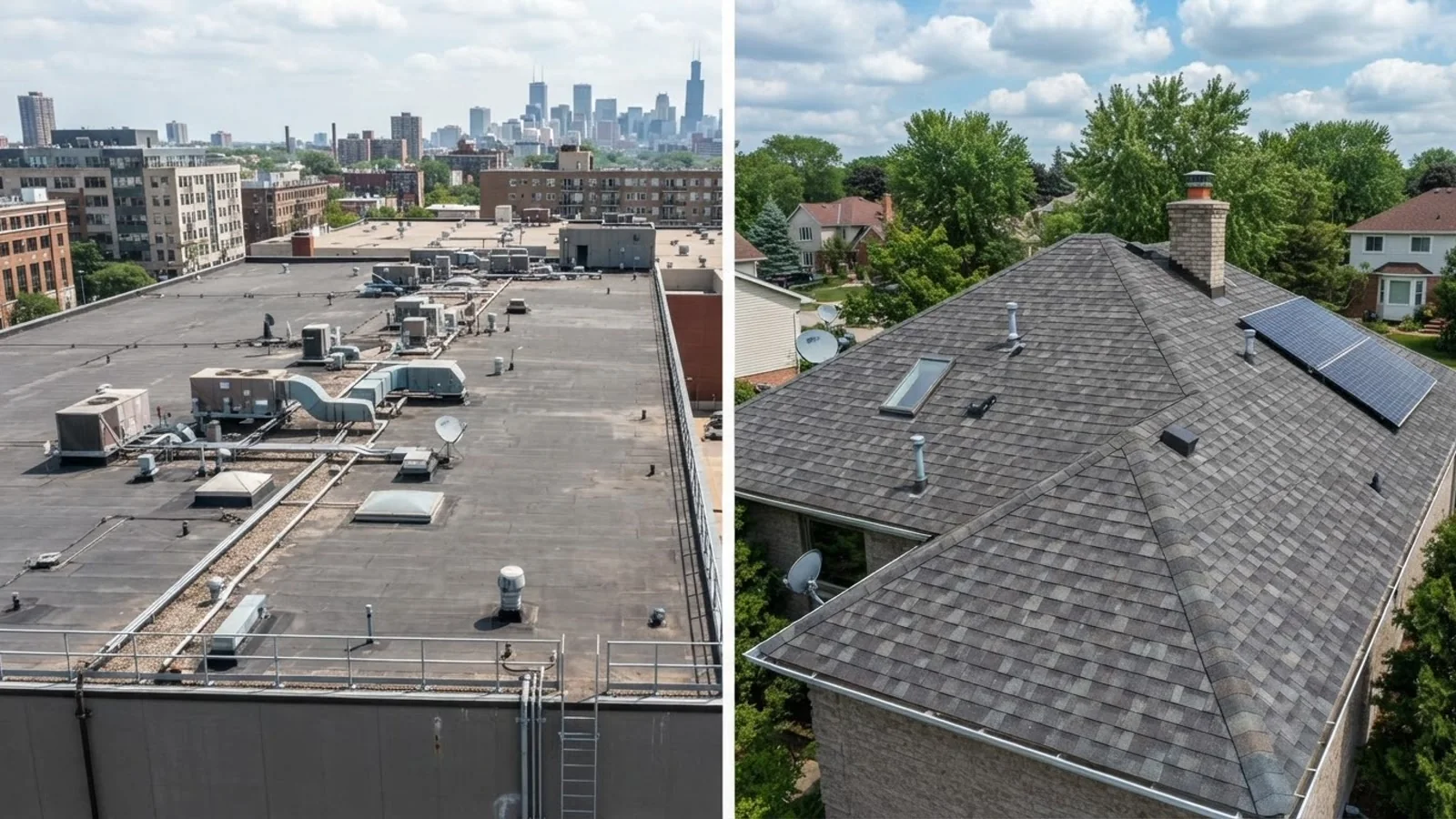
A commercial roof is built for function first. Because the deck is flat or low-slope, it has to move water sideways to drains rather than letting gravity shed it off a pitch. It also serves as a work platform, HVAC units, condensers, solar arrays, and vents all live up there, and the roof has to carry that weight and foot traffic without failing.
Scale is the other big difference. A typical Triangle home roof runs roughly 1,500 to 2,000 square feet; a commercial roof can cover tens of thousands. That size, plus the flat profile, is why commercial roofing is its own trade with its own materials and failure modes.
Commercial / low-slope
- Flat or low-slope deck
- Membrane or built-up systems
- Carries HVAC, solar, foot traffic
- Drains and internal scuppers
- Priced and sold per square foot
Residential / steep-slope
- Sloped, water sheds by gravity
- Shingles, metal, tile, slate
- Curb appeal drives choices
- Gutters and downspouts
- Covered in my homeowner roofing guide
The main commercial roofing systems
Most flat roofs in the Triangle fall into a handful of families. Here's how I explain them to owners walking a building.
Single-ply membranes: TPO, EPDM, PVC
These are large sheets of synthetic material rolled out and sealed at the seams. TPO is a reflective white membrane that's popular for cutting cooling load. EPDM is a durable black rubber that has held up on flat roofs for decades. PVC is the premium choice where you need chemical and grease resistance, think restaurants or buildings with heavy rooftop exhaust. Single-ply is lightweight, relatively quick to install, and the workhorse of modern commercial roofing.
Built-up roofing (BUR)
The old, proven system: alternating layers of bitumen and reinforcing fabric, finished with gravel or a cap sheet. It's a layer cake, heavy, redundant, and very good at waterproofing. You'll still find it on older Triangle office and institutional buildings.
Modified bitumen
A middle ground between built-up and single-ply. It's tough, flexible, and handles temperature swings well, which matters through a Carolina summer-to-winter cycle. It can be torched or self-adhered in layers.
Drainage: where flat roofs live or die
On a sloped house roof, water leaves on its own. On a flat commercial roof, water only leaves if you designed and maintained a way out. That's why drainage is the single most important thing I tell owners to watch.
Ponding water, standing pools that don't drain within a day or two, is the number one cause of premature commercial roof failure. It adds weight, breaks down membranes, and finds every weak seam. A healthy commercial roof needs a slight taper toward drains, clear internal drains and scuppers, and someone actually clearing debris before storm season.
On a flat roof, you don't fight the rain, you route it. A blocked drain is a leak waiting for the next storm.
Building or buying new? Let’s make sure the builder’s contract works for you — not just for them.
Schedule a New Construction ConsultationLifespan, maintenance, and protecting your warranty
Commercial roofs reward a systematic approach. Homeowners can get away with a look-twice-a-year habit. As an owner, you want a real program.
- Put a maintenance contract in place.Scheduled inspections, cleaning, and small repairs catch problems while they're cheap. Most manufacturer warranties actually require documented maintenance to stay valid.
- Inspect after weather and around equipment.Commercial roofs take abuse residential ones never see: chemical exposure from HVAC exhaust, foot traffic from service techs, and the weight of rooftop units. Those spots fail first.
- Keep drains and seams clear.Debris in a drain becomes ponding water becomes a leak. Seams and flashings around penetrations are the usual entry points.
- Log everything.An inspection and repair history protects your warranty and becomes real leverage when a buyer's inspector climbs up during due diligence.
Handled this way, a quality membrane or built-up system can serve for two to three decades. Neglected, the same roof can fail in a fraction of that.
Cost: think lifecycle, not sticker
Commercial roofs are priced per square foot, and the range is wide because it depends on the system, the deck, tear-off versus recover, insulation, and how much equipment is up there. Rather than chase a number that dates quickly, I'd get bids from qualified commercial contractors on your specific building and confirm current pricing.
What matters more than the sticker is the lifecycle math. A cheaper install that needs constant patching and dies early usually costs more than a better system on a maintenance plan. Two levers work in your favor over the hold period:
- Energy performance. Reflective "cool roof" membranes like white TPO cut cooling load on a big footprint, which shows up on the operating statement.
- Longevity and downtime. A roof that doesn't leak protects your tenants, your rent roll, and the building's value at sale. Roof failures during a lease are the kind of surprise that sours tenant relationships fast.
Why this matters to an owner or investor
The roof is a capex event you can see coming if you're paying attention. When I help clients evaluate a building, roof age and condition go straight into the numbers, because a roof near end-of-life is a six-figure item a buyer will price in or negotiate down.
If you're weighing the broader picture of owning income property, I get into that in investing in commercial properties, and if you're newer to this asset class, start with commercial real estate basics. The roof is one piece of the diligence puzzle, but it's a piece that catches a lot of first-time owners off guard.
One note: I'm a Realtor, not a licensed roofing contractor or structural engineer. Before you buy, budget a roof replacement, or rely on a warranty, get a qualified commercial roofing professional up there for a real inspection and confirm the details with them.
Building or buying new? Let’s make sure the builder’s contract works for you — not just for them.
Schedule a New Construction ConsultationFrequently Asked Questions
If you're buying, holding, or getting ready to sell commercial property in Raleigh, Durham, Cary, or anywhere in the Triangle, my team and I can help you fold the roof and the rest of the building into a clear-eyed number. Reach out and we'll walk it with you.
Building or buying new? Let’s make sure the builder’s contract works for you — not just for them.
Schedule a New Construction Consultation