A $2 million custom-home budget buys choices. It also creates expensive ways to make the wrong ones.
CJC Custom Homes is a Raleigh-based luxury builder whose current work spans raleigh, wake-forest, cary, and Pinehurst. The company says it has more than 15 years of custom-building experience, more than 60 completed homes, and projects that typically begin around $2 million. Its portfolio moves between traditional estates, transitional family homes, and cleaner contemporary designs.
Those numbers establish the tier. They do not answer the questions that determine whether a builder is right for your land, budget, and tolerance for decisions. This guide separates CJC’s documented work from the items a buyer still needs to verify before signing.
Who Is CJC Custom Homes?
CJC Custom Homes is a luxury custom builder serving Raleigh and the surrounding Triangle, with a stated focus on personalized design, premium materials, and close coordination among the homeowner, architect, designer, and construction team.
The documented history
CJC’s current website reports 15+ years building custom homes and 60+ completed homes. A Frank Betz Associates builder directory adds historical context: it says Chip formed CJC Custom Homes in November 2008 after working in construction and project management for years. The company name reportedly comes from his sons, Jordan and Colby.
The current CJC site does not publish a detailed leadership page, staff roster, or license number. Before treating any directory biography or licensing statement as current, confirm the responsible qualifier and license status directly with the North Carolina Licensing Board for General Contractors.
Where CJC builds
CJC identifies four primary markets:
- Inside the Beltline and Raleigh: established neighborhoods, infill lots, and private homesites;
- Wake Forest: custom residences shaped around the land and the owner’s design goals;
- Cary: greater-Triangle custom projects, subject to lot and jurisdiction requirements;
- Pinehurst: luxury homes outside the Triangle in a golf-oriented market.
“Build on your lot” is part of CJC’s offer. That makes the homesite a first-order decision. Tree removal, grading, stormwater, utility connections, driveway length, retaining walls, and unsuitable soil can move six figures before the kitchen selections begin.
What Does CJC Custom Homes Build?
CJC builds one-off luxury residences rather than a catalog of fixed production plans. Its public portfolio shows traditional, transitional, and modern work, but the company presents each home as a response to its owner and site.
| Buyer question | What the public record shows |
|---|---|
| Starting budget | CJC says projects typically begin around $2 million, depending on design and location. |
| Project type | Fully custom residences on private or infill homesites. |
| Architectural range | Traditional estates, transitional family homes, and modern custom residences. |
| Primary markets | Raleigh, Inside the Beltline, Wake Forest, Cary, and Pinehurst. |
| Design model | Collaboration with the homeowner, architect, designer, and craftsmen. |
| Published portfolio scale | CJC says it has completed more than 60 homes. |
The phrase “projects starting at $2 million” needs a precise definition during the consultation. Ask whether that figure includes the lot, architectural and engineering fees, site work, landscaping, appliances, window treatments, pool, detached structures, financing carry, and contingency. A custom-home number without defined inclusions is a conversation starter, not a budget.
A current North Hills example
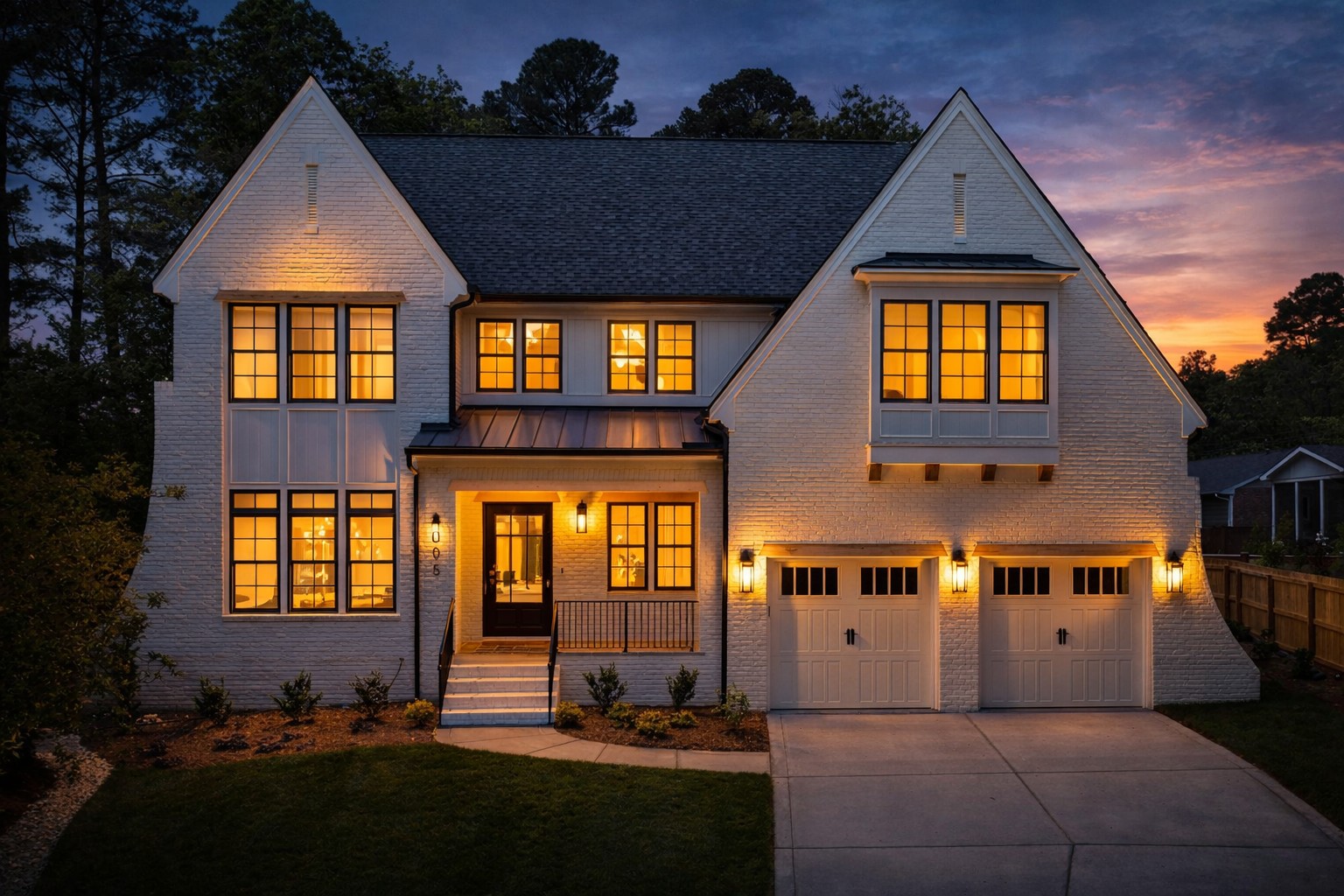
The 2026 Triangle Parade of Homes documents CJC’s residence at 4907 Yadkin Drive in north-hills. At the time of this review, the entry listed 5,445 square feet, five bedrooms, seven bathrooms, and a $3.895 million price. Its published design combines contemporary lines, stone and siding, large windows, an upper terrace, and a three-car garage.
That house is useful evidence of current scale and execution. It should not become the automatic specification for another buyer’s project. Compare it with homes that match your intended lot conditions, square footage, structural system, and finish allowance.
How Does the CJC Building Process Work?
CJC describes a five-stage building process that carries the project from the first discussion through the final walkthrough.
- Initial consultation: The conversation covers the buyer’s vision, homesite, desired timeline, and design goals.
- Architectural design: CJC collaborates with architects and designers to translate the household’s needs into a site-specific plan.
- Planning and budgeting: Plans, scope, and budget are developed before construction begins.
- Construction: The team manages construction, craftsmanship, communication, and quality control.
- Completion and walkthrough: Builder and buyer review the finished home against the agreed standards.
The sequence is sensible. The contract determines how well it protects the buyer.
Turn the five stages into written deliverables
Each stage should end with documents that both sides can identify. Design should produce approved plans and specifications. Budgeting should produce a detailed price, allowance schedule, exclusions list, and change-order rules. Construction should come with an update cadence, draw schedule, inspection access, and a method for documenting decisions. Completion should define substantial completion, punch-list timing, closing conditions, and warranty service.
If a decision matters enough to change the price or completion date, it belongs in writing.
What Should You Verify Before Signing With CJC?
Before signing with CJC Custom Homes, verify the team, scope, money, schedule, and post-closing obligations attached to your specific project. A beautiful portfolio proves design capability. Due diligence tests repeatability. Our guides to finding a Triangle builder and understanding the builder’s agent explain how to build that comparison team.
Ask for comparable projects and client references
Request three completed projects that resemble yours in budget, size, architecture, jurisdiction, and lot difficulty. Speak with the owners without the builder present if they agree. Ask:
- How close was the final cost to the preconstruction budget?
- Which allowances were least realistic?
- How were change orders priced and approved?
- Who communicated day to day?
- What delayed the schedule?
- How quickly were punch-list and warranty items resolved?
CJC’s current website does not publish a dedicated testimonial page or detailed third-party review summary. That makes recent client references more important, not less.
Separate hard cost from allowances
Custom estimates often mix fixed prices, allowances, and items excluded entirely. Put each cost into one of those categories. Then pressure-test the allowance amounts against the actual products you expect to select.
A $40,000 cabinet allowance is not generous or lean by itself. The answer depends on cabinet construction, finish, door style, hardware, layout, installation, and whether the number includes ancillary spaces. Run the same test on lighting, plumbing, tile, countertops, appliances, landscaping, and site work.
Define changes before changes happen
The change-order clause should state the builder markup, documentation required, schedule effect, and when payment is due. It should also distinguish a buyer-requested upgrade from an error, omission, concealed condition, or code requirement.
Late decisions cost more because they can trigger redesign, restocking fees, rework, and trade rescheduling. A complete selection calendar saves more money than chasing discounts after construction starts.
Verify supervision, insurance, and warranty
Ask who will supervise the site, how many other projects that person manages, and how often CJC’s leadership visits. Confirm the contracting entity, current North Carolina license, general liability coverage, workers’ compensation coverage, subcontractor insurance requirements, lien-waiver procedure, and written warranty.
Do not accept “industry standard” as the warranty description. Get the coverage, exclusions, claim process, and service timelines in the contract package. Use the home-builder warranty guide to compare the written coverage before the deposit becomes nonrefundable.
How Does CJC Compare With Other Building Options?
CJC’s full-custom model gives the buyer more control than a production or semi-custom program, but that control carries more design work, more pricing variables, and more decisions.
| Building model | Plan flexibility | Price certainty | Buyer decisions | Best fit |
|---|---|---|---|---|
| Production builder | Low | Higher earlier | Fewer | Buyers who value speed and a known plan set |
| Semi-custom builder | Moderate | Moderate | Moderate | Buyers who want personalization inside a defined system |
| CJC-style full custom | High | Develops with plans and specifications | Many | Buyers prioritizing the site, architecture, and a one-off result |
Full custom is not automatically better. It is better when the buyer wants the control, has the budget for the site and design, and can make decisions on schedule. A household that wants a guaranteed move-in date and a short selection list may be happier with a different building model.
Who Is a Strong Fit for CJC Custom Homes?
CJC Custom Homes fits a buyer who wants a distinct luxury residence and is prepared to treat the build like a major development project.
The strongest candidates usually have:
- a realistic all-in budget above the builder’s stated starting point;
- a lot already owned or enough flexibility to reject a bad homesite;
- clear priorities but openness to architectural and engineering advice;
- time for design decisions, pricing reviews, and scheduled site meetings;
- an independent agent and attorney reviewing the transaction from the buyer’s side.
This is not the right process for someone choosing a builder from photographs alone. At this price, the contract, allowances, soil, drainage, mechanical design, envelope details, supervision, and warranty matter just as much as the elevation.
Final Thoughts About CJC Custom Homes From Tim Clarke
CJC has documented experience, a portfolio that reaches from Wake Forest estates to North Hills infill, and a current Parade entry that shows the level at which the company is building. That earns them a place on a serious Raleigh luxury buyer’s interview list.
It does not earn anyone a blank check.
I have spent 17+ years in Triangle real estate, and the custom builds that go well have one thing in common: the buyer makes the important decisions before the slab goes down. Start with the land. Price the site work honestly. Match every allowance to the finish level you expect. Then put the communication schedule, change-order markup, completion standard, warranty, and exclusions in writing.
The cheapest line item is rarely where the money is saved. Money is saved by catching a steep driveway before closing on the lot, finding the missing landscaping allowance before signing, and choosing the mechanical and building-envelope details before drywall hides them.
If CJC is on your shortlist, bring us the lot, preliminary plans, proposal, and allowance schedule. We will compare the real cost, identify the gaps, and help you decide whether the builder and the site fit the life you are trying to build.